Le premier joueur tourne la feuille de façon à ce que son bord le plus long soit en haut et écrit une lettre au centre.
À tour de rôle, dans le sens des aiguilles d'une montre, les joueurs effectuent l'une des actions suivantes :
1. Ajouter une lettre à chaque extrémité de la suite de lettres qui s'étend sur la feuille.
2. Ajouter une lettre comme indiqué ci-dessus et souligner un mot composé de lettres consécutives, dans un sens ou dans l'autre, visible dans la suite, à condition qu'il n'ait pas déjà été marqué.
Le joueur ajoute à son score un nombre de points égal au nombre de lettres du mot.
3. Souligner un mot comme indiqué ci-dessus et marquer des points en conséquence, sans ajouter de lettre.
Le gagnant est le premier joueur à atteindre 50 points, ou tout autre score convenu.
The first player turns the paper so that its longest edge forms the top of the sheet and writes a single letter in the centre of the sheet.
The players now take turns, in a clockwise order, to carry out one of the following actions:
1 Add one letter at either end of the string of letters stretching across the sheet.
2 Add one letter as above and underline any single word formed of contiguous letters, backwards or forwards, which can be seen within the letter string, provided the word has not already been marked in this way.
The player adds to his score a number equal to the num ber of letters in the word.
3 Underline any single word as above and score accordingly, without adding a letter to the string.
The winner is the player first reaching a score of 50, or any other agreed number of points.
Il est important de comprendre ce qui constitue un mot valide dans le contexte de ce jeu.
Un mot peut être comptabilisé lors des coups de type 2 et 3 à condition qu'il diffère par au moins une lettre de tout mot déjà comptabilisé.
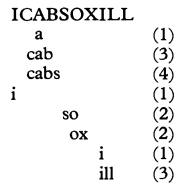
Voici quelques exemples de mots valides.
Au lieu d'être soulignés, les mots sont répétés sous leur position dans la chaîne.
Le nombre entre parenthèses représente le point à ajouter au score du joueur qui marque le mot.
It is important to understand what constitutes a valid word in the context of this game.
A word may be scored in moves of types 2 and 3 provided that it differs in at least one letter from any previously scored word.
Here are some examples of permissible scoring words.
Rather than underline, the words have been repeated underneath their positions in the string.
The number in brackets represents the amount to be added to the score of the player marking the word.
Comme dans la plupart des jeux de mots, il est interdit de marquer les noms propres, les mots composés et les mots nécessitant une apostrophe, tels que « DON'T ».
Les mots d'une seule lettre sont toutefois autorisés, ce qui incitera à marquer les voyelles I et A.
Les joueurs peuvent autoriser les voyelles restantes O, E et U à être marquées comme des mots valant un point.
As in the majority of word games, the marking of proper nouns, hyphenated words and words requiring an apostrophe, such as “DON’T ”, is not allowed.
Single-letter words are permissible, though, which will tend to encourage the placing of the vowels I and A.
Players may wish to permit the remaining vowels O, E and U to be marked as words scoring one point.
Dans ce jeu, il est rare de trouver des mots longs de sept lettres ou plus ; il est donc important d’accumuler régulièrement de petits scores.
Une bonne connaissance des mots de deux ou trois lettres plus rares, comme EM, T I, ZAX, etc., est un atout.
Bien sûr, un bon dictionnaire est indispensable, mais il ne faut pas le consulter avant son tour.
On peut jouer à Letter-Strings à deux avec un niveau de jeu satisfaisant, mais à plus de joueurs, la chance joue un rôle plus important.
The marking of long words of seven letters or more is a rare occurrence in this game so the regular accumulation of small scores is important.
A good knowledge of the more unusual two- and three-letter words such as EM, T I, ZAX, etc., is an asset.
Of course, a good dictionary should be on hand, though it shouldn’t be scanned prior to a player’s turn.
Letter-Strings may be played by two players at a fair level of sophistication, but with more players luck plays a larger part.