Subterfuge, un jeu d'espionnage avec des enchères secrètes
Subterfuge, a spy game with secret bidding
Jeux de papier et de crayon / Paper & pencil games
|
Subterfuge est un nouveau jeu d'espionnage postulant des pratiques
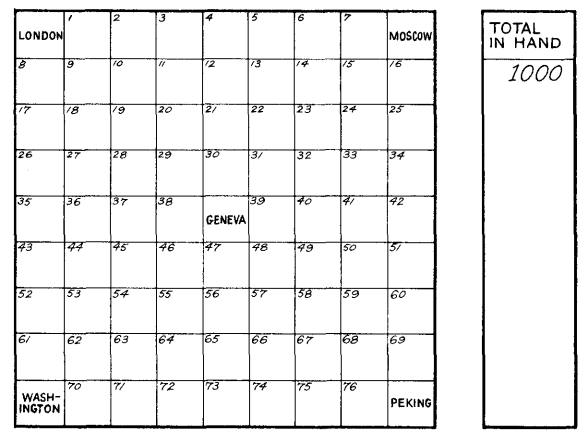
des plus immorales, enregistrées secrètement par les joueurs. Ces agents, d'une paresse légendaire, restent à des positions fixes sur la feuille de jeu. Leur rôle se limite à s'échanger des plans volés sous les ordres des joueurs. À tout moment, un agent travaille uniquement pour le joueur qui lui a versé le plus gros pot-de-vin. Chaque joueur commence la partie avec une feuille de papier identique, quadrillée en forme d'échiquier. L'échiquier comporte neuf cases sur la longueur et neuf sur la largeur. Toutes les cases, à l'exception des cases d'angle et du centre, contiennent les numéros d'identification des agents secrets. Ces agents sont chargés de transférer des plans volés – les « documents » – de Genève, située au centre de l'échiquier, vers l'une des cases d'angle. Chaque joueur représente l'une des puissances intéressées par l'acquisition des documents. La case en haut à gauche représente Londres et est le « domicile » du joueur britannique. Les autres coins sont, dans le sens horaire, Moscou, Pékin et Washington. Il peut y avoir deux, trois ou quatre joueurs. À tour de rôle, les joueurs ont le choix entre deux actions : 1. Corrompre un agent avec 1 ou plus. 2. Transférer les papiers de l'agent qui les détient actuellement à un agent situé sur une case adjacente. Le capital disponible pour les pots-de-vin est limité à 1 000. |
Subterfuge is a new spy game postulating a most
unethical and recorded secretly by the
players. These agents are lazy devils and remain at fixed positions on the game-sheet. All they do is to post some stolen plans to one another under the direction of the players. At any time an agent is working only for the player who has paid him the highest bribe. Each player starts the game with an identical sheet of paper on which is drawn a chess-board pattern of squares. There are nine squares down and nine squares across and all but the corner and center squares contain the identity numbers of secret agents. The agents are used to transfer some stolen plans—the “papers”—from Geneva, located at the center of the squared pattern to one or other of the corner squares. Each player acts for one of the powers interested in acquiring the papers. The top left-hand square is London and “home” for the British player. The other corners are, in clockwise order, Moscow, Peking and Washington. There may be two, three or four players. The players take turns and have the choice of doing one of two things as follows (it is not permitted to pass your turn): 1 Bribe one of the agents with an amount of 1 or more. 2 Move the papers from the agent currently holding them to an agent in an adjacent square. The capital available to each player for making bribes is limited to 1,000. |
|
Pots-de-vin : Pour effectuer un tour de type 1, inscrivez secrètement le montant de votre pot-de-vin dans la case correspondant à l’agent concerné. Vous déduisez ensuite ce montant de votre capital et indiquez que c’est au tour du joueur suivant. Il est important de noter que les pots-de-vin déjà versés ne peuvent pas être augmentés. Si vous estimez qu’un pot-de-vin est insuffisant, vous devez en verser un nouveau pour l’agent que vous souhaitez corrompre. Votre précédent pot-de-vin est définitivement perdu. |
Bribes: To execute a turn of type 1 you secretly write the amount of your bribe in the square corresponding to the agent concerned. You then deduct this amount from your capital in hand and indicate that it’s the next player’s turn. It is important to note that existing bribes cannot be increased by the addition of money. If you feel that a bribe is too small you must make a brand-new bribe for the particular agent you wish to subvert. Your previous bribe money is totally lost. |
|
Déroulement du jeu : Un tour de type 2 consiste simplement à annoncer que vous déplacez les papiers, par exemple, de l’agent 10 à l’agent 11. L’agent 10 doit tenir les papiers au début du tour et l’agent 11 doit se trouver sur une case adjacente à celle de l’agent 10. Une case adjacente est une case que l’on peut atteindre sans traverser aucune autre case. Les cases au centre de la feuille ont huit cases adjacentes et celles aux coins en ont trois. Ainsi, les papiers se déplacent comme un roi aux échecs. Vous gagnez lorsque vous parvenez à déplacer les papiers d’un agent adjacent à votre ville d’origine jusqu’à votre ville d’origine. La manière la plus simple de représenter le trajet des papiers est de tracer une ligne continue à travers les cases. Cette ligne est prolongée à chaque fois qu’un joueur réussit à déplacer les papiers. Notez le mot « réussit » ; tous les déplacements ne sont pas couronnés de succès, ce qui nous amène au but du jeu. |
Moves: A turn of type 2 is taken by simply stating that you are moving the papers from, say, agent 10 to agent 11. Agent 10 must be holding the papers at the start of the turn and 11 must be in a square adjacent to 10. An adjacent square is one which can be reached without crossing any other square. Squares in the middle of the sheet have eight adjacent squares and those at the corners have three. Thus the papers move like a king in chess. You win when you succeed in moving the papers from one of the agents adjacent to your home town into your home town. The easiest way to record the route taken by the papers is to draw a smooth connected line through the squares. The line is extended each time someone succeeds in moving the papers. Note the word “succeeds” ; not all moves are successful, which brings us to the point of the game. |
|
Contestations : Supposons qu'un de vos adversaires déplace les jetons de la case 11 à la case 21. Si vous avez un pot-de-vin conséquent sur la case 21, vous ne vous opposerez probablement pas à ce que les jetons vous soient offerts de cette manière. Mais supposons que vous ayez un pot-de-vin sur la case 11, peut-être même un pot-de-vin important. Vous souhaiterez probablement contester que votre adversaire donne des instructions à « votre » pion sur la case 11, et c'est tout à fait votre droit. Une telle objection s'appelle une contestation. Vous contestez la validité du coup de votre adversaire. Voici un problème : Comment déterminer avec certitude qui possède la case 11 ? Qui a, en réalité, placé le plus gros pot-de-vin sur la case 11 ? La solution la plus simple est que vous et votre adversaire annonciez la valeur de vos pots-de-vin. Le problème avec cette méthode est qu'elle révèle le montant du plus gros pot-de-vin, après quoi n'importe qui saura quelle somme d'argent il doit proposer pour prendre le contrôle de 11. |
Challenges: Suppose one of your opponents moves the papers from 11 to 21. If you have a fair-sized bribe on 21 you’ll probably not object to being made a present of the papers in this way. But suppose you have a bribe on 11, per haps it is a large bribe. You will probably wish to object to your opponent giving instructions to “your” man 11 and this is just what you are entitled to do. Such an objection is called a challenge. You are challenging the validity of your op ponent’s move. Now there’s a problem: How do you resolve who definitely owns 11? Who has, in fact, placed the largest bribe in the square marked 11? The obvious way to discover this is for both your opponent and yourself to announce the value of your bribes. The trouble with this method is that it reveals the size of the largest bribe, after which anybody will know what sum of money they must bid to gain control of 11. |
|
Résolution de la question de propriété : Après le défi, l’un des joueurs, peu importe lequel, demande à l’autre : « Peux-tu battre 10 ?» Le montant annoncé doit être inférieur au pot-de-vin versé par le joueur qui a posé la question à l’agent concerné, par exemple 11. Si l’autre joueur a versé un pot-de-vin supérieur à 10 pour atteindre 11, il répond « Oui ». Le joueur qui a posé la question répète alors la question en annonçant une somme plus importante, qui doit toujours être inférieure à son pot-de-vin. L’autre joueur répond, et ainsi de suite, la somme annoncée augmentant progressivement, jusqu’à ce que l’un des deux joueurs ne puisse plus aller plus loin. Ainsi, à la fin de la discussion, les joueurs savent seulement lequel des deux possède 11 et approximativement le montant du pot-de-vin perdu. À ce stade, d’autres joueurs peuvent vouloir poursuivre le défi en reprenant la somme mentionnée précédemment. Voici un exemple de défi : Il y a quatre joueurs : John, qui a placé 45 sur l’agent 11 ; Mary, qui a placé 65 ; Harry, qui a placé 110 ; et Jill, qui n’a aucun pot-de-vin sur le 11. Le défi est lancé par John lorsque Mary tente de faire passer les papiers du 11 au 21. Voici comment le défi a été résolu : Mary : « Je déplace les papiers du 11 au 21. » John : « Je conteste ! Le 11 me convient.» Mary : « Peux-tu faire mieux que 10 ?» John : « Facilement, il te faudra faire mieux que ça.» Mary : « D’accord, peux-tu faire mieux que 25 ?» John : « Oui.» Mary : « Et 40 ?» John : « Oui, je peux faire mieux.» Mary : « Peux-tu faire mieux que 50 ? » John : « Non, je suis désolé, mais je ne peux pas. » À ce moment-là, Harry, qui mène 110 contre 11, décide de relever le défi. Il n'est évidemment pas obligé de le faire. Harry : « Doucement, Mary, je veux te défier. Peux-tu faire mieux que 65 ? » Mary : « Eh bien, je ne peux pas vraiment faire mieux. Et toi ? » Harry : « Absolument. Ton défi est donc réussi. » À noter que le pot-de-vin conséquent de 110 versé par Harry reste secret. Jill n'a pas participé à ce défi. |
Resolving ownership: After the challenge, one of the players, it does not matter whom, asks the other “Can you beat 10?” The actual amount stated must be less than the questioner’s bribe on the agent concerned, say 11. If the other player has bribed 11 with a sum greater than 10 he replies “Yes”. The questioner now repeats the question but quoting a larger sum of money, which must still be less than his bribe. The other player replies, and so it goes on, the sum quoted slowly rising, until one player or the other can go no further. Thus at the end of the discourse the players know only which of the two owns 11 and roughly the amount of the losing bribe. At this point there may be other players who want to continue the challenge starting at the sum last mentioned. Here is an example of a challenge: there are four players, John who has placed 45 on the agent 11, Mary who has placed 65, Harry who has placed 110 and Jill who has no bribe at all on 11. The challenge is first made by John when Mary tries to pass the papers from 11 to 21. This is how the challenge was resolved. Mary: “I move the papers from 11 to 21.” John: “I challenge that—11 is working for me.” Mary: “Can you beat 10?” John: “Easily, you’ll have to do better than that.” Mary: “OK, can you beat 25?” John: “Yes.” Mary: “How about 40?” John: “Yes, I can beat that.” Mary: “Can you beat 50?” John: “No, I ’m sorry to say I can’t.” At this point Harry, who has 110 on 11, decides to take up the challenge. He does not have to do so if he doesn’t wish, of course. Harry: “Hold your horses Mary, I want to challenge your move. Can you beat 65 ?” Mary: “Well, I can’t exactly beat it. Can you?” Harry: “Certainly, so you’ve been successfully challenged.” Note that Harry’s large bribe of 110 is still a secret. Jill took no part in this challenge. |
|
Résultat d'une contestation : Il est facile de deviner la suite. Marie, ayant perdu la contestation, doit rapporter les documents à l'agent 11 et perd ainsi son tour. Si la contestation, lancée conjointement par Jean et Harry, avait échoué, Marie aurait bénéficié d'un tour supplémentaire. Elle aurait pu l'utiliser pour consolider les documents avec l'agent 21 en lui offrant un important pot-de-vin, ou tenter de les rapprocher encore davantage de chez elle en les transférant de 21 à un autre agent. Notez que ce dernier tour aurait lui-même pu être contesté. Tout tour de type 2 peut être contesté. Bien entendu, le versement d'un pot-de-vin est illégal. |
Result of a challenge: It isn’t difficult to guess what happens next. Mary, who has lost the challenge, must return the papers to 11 and effectively loses her turn. If the challenge, made jointly by John and Harry, had been unsuccessful then Mary would have been awarded an extra turn. She might have used this to consolidate the papers with agent 21 by placing a large bribe on him, or she might have attempted to get the papers even nearer to home by moving them from 21 to some other agent. Note that the latter turn may itself have been challenged. Any turn of type 2 may be challenged. Obviously, nobody can challenge the placing of a bribe. |
|
Ordre des contestations : Lorsqu’un joueur a déplacé les cartes, chaque autre joueur a le droit de contester ce déplacement, mais les contestations doivent être effectuées dans l’ordre normal du jeu. Autrement dit, le joueur assis à la gauche du joueur qui a déplacé les cartes a la priorité pour contester. S’il choisit de ne pas contester le déplacement, ou si sa contestation échoue, le joueur suivant assis à sa gauche peut contester, et ainsi de suite. Dans l’exemple de tour de contestation ci-dessus, les joueurs étaient assis dans l’ordre suivant : Marie, Jean, Harry et Jill. Une fois les contestations terminées, le joueur suivant à jouer est celui assis à gauche du dernier joueur à avoir déplacé les cartes, et non le dernier joueur à avoir contesté. Dans l’exemple, le joueur suivant à jouer aurait été Jean, qui était assis à la gauche de Marie. |
Challenging order: When a player has moved the papers, every other player has the right to challenge the move but the challenges must be issued in the normal order of play. That is, the player sitting on the mover’s left is given the first option to challenge. If he chooses not to challenge the move, or if he fails in his challenge, the next player sitting on the latter’s left is allowed to challenge, and so on. In the sample round of challenges above, the players were sitting in the order: Mary, John, Harry and Jill. After the challenging is over the next player to move is the person sitting on the left of the last mover, not the last challenger. In the example the next person to move would have been John who was sitting on Mary’s left. |
|
Stratégie : Quelle est la meilleure stratégie pour gagner à Subterfuge ? Si la réponse était simple, ce jeu n'intéresserait guère de monde. Le facteur déterminant est sans doute la psychologie des adversaires. Certains joueurs privilégient une approche directe et audacieuse. Ils n'hésitent pas à soudoyer généreusement les agents qui font le trajet direct de Genève à leur ville et tentent d'y faire parvenir les documents en urgence. Il suffit qu'un seul joueur verse un pot-de-vin important pour bloquer leur route et mettre le « tricheur » en difficulté. Il aura dépensé la majeure partie de son argent et les documents auront été détournés du chemin emprunté par ses agents « fiables ». Cependant, s'il y a plus de deux joueurs, le risque est que chacun laisse aux autres le soin d'organiser le pot-de-vin. En règle générale, les débutants commettent l'erreur de ne pas dépenser suffisamment et deviennent des proies faciles pour le tricheur. Concernant le début de la partie, il est important de noter que, puisque les documents sont transmis d'agent en agent, ils ne peuvent pas revenir sur la place de Genève. Ainsi, le joueur qui les déplace en premier vers sa ville d'origine possède un certain avantage sur le joueur situé en diagonale opposée. Ce dernier devra emprunter un chemin plus détourné. |
Strategy: What’s the best strategy for winning Subterfuge? If that were easy to answer there would be little interest in the game. Perhaps the over-riding factor is the psychology of one’s opponents. Some players favour a bold, direct approach. They will quickly place large bribes on the agents leading straight from Geneva to their home town and will try to rush the papers there. It requires only one player to place one high blocking bribe on their path and the “hustler” will be in trouble. He will have spent most of his money and the papers will have been taken off the path occupied by his “safe” agents. If there are more than two players, however, there is the danger that each player will leave it to the others to arrange the blocking bribe. As a rule beginners make the error of spending too little and are usually easy prey for the hustler. As regards the start of the game it should be noted that since the papers are handed from agent to agent they can not re-visit the Geneva square. Thus the player who first moves them towards his home town has something of an advantage over the player diagonally opposite him. The latter player will have to take a more roundabout route. |
|
Variantes : Les règles présentées ici ne sont pas immuables et vous pouvez tout à fait essayer des variantes. Par exemple, vous pouvez jouer sur une feuille beaucoup plus grande, disons 15 cases sur 15, et attribuer une somme d’argent plus importante à chaque joueur. Une autre variante, qui allonge la durée de la partie, consiste à interdire les déplacements en diagonale. Les joueurs ne pourront alors se déplacer que d’une case sur une rangée ou une colonne. |
Variations: There’s nothing sacrosanct about the rules presented here and you should feel free to try variations. For instance you could play the game on a much larger sheet, say 15 squares by 15 squares, and allocate a larger sum of money to each player. Another variation which leads to a longer game is to prohibit diagonal moves. The papers would be restricted to moving one square along a rank or a file. |